The early inhabitants of Asia Minor, Thrace, and Greece appear to be the same people. The Leleges, Caucones, and Pelasgians are mentioned by Strabo as the principal names among those who in earliest times occupied Greece. In Grecian mythology we find continual referrences to Asiatic stories; and even in the heroic ages the Greeks and Asiatics appear to have communicated as a kindred people. The inhabitants of Thrace, who were not distinguished by Homer for that peculiar barbarism which afterwards characterised them, were reduced to that state by the incursions of northern hordes, which followed the Trojan War.
The first powerful settlement upon the coast of Asia Minor was that of TROY. The state of Troy, according to Homer, was founded by Dardanus, who claimed descent from Zeus. Dardanus founded the town of Dardonia in north-western Asia Minor. His son Erichthonius, who succeeded him in the sovereignty of this territory, was the richest man of his age. Much of his wealth was derived from a large stock of brood mares, to the number of three thousand, which b his care and judgement in the choice of stallions produced a breed superior to an of the surrounding countries. Tros son of Erichthonius extended or improved the territory of Dardanus. Tros was succeedd by Ilus, who was succeeded by Laemedon, who was the father of Priam.
A frequent and often hostile communication was maintained between the eastern and western coasts of the Aegean, ea. being an object of plumder. Rape was a kind of fashion, in consequence of which the leaders of piratical expeditions gratified their vanity when they could carry off a lady of superior rank.
The expedition of Paris, son of Priam kind of Troy, into Greece, was a marauding adventure, such as was then usual. Paris concluded his visit at Sparta with carrying off Helen wife of Menelaus. This outrage urged the united revenge of all the Grecian chiefs.
The Greek army, landing on the Trojan coast, was immediately so superior to the enemy as to oblige them to seek shelter within the city walls. But the Trojan walls were singularly strong. Agamemnon was therefore reduced to turning the siege into a blockade, and patiently waiting till want of necessities should force the enemy to quit their shelter. Supplies, however, could not be found equal to the maintenance of the Greek army. A part of their army was therefore sent to cultivate the vales of the Thracian Chersonese, then abandoned by their inhabitants.
Large bodies being detached, ...
Saturday, 2 April 2011

0004 - THESEUS
Aegeus, when past the prime of his life, had the misfortune to remain childness. He went to Delphi to implore information from the oracle how a child might be obtained. Receiving an unintelligle answer, he applied to prince Pithheus of Troezen to help explain the oracle. In consequence of some fancied meaning in the oracle, Pithheus introduced his own daughter Aethra to an illicit intercourse with Aegeus. Aethra presently bcame pregnant, while the affairs of Attica required the return of Aegeus. Before his departure, he called Aethra to a small cave. Depositing there a hunting knife and a pair of sandals, he covered them (the knife and sandals) with a rock. Addressing Aethra, "If," said he, "the child should prove a boy, let the removal of this stonr one day be the proof os his strength; when he can effect it, send him with the tokens to Athens."
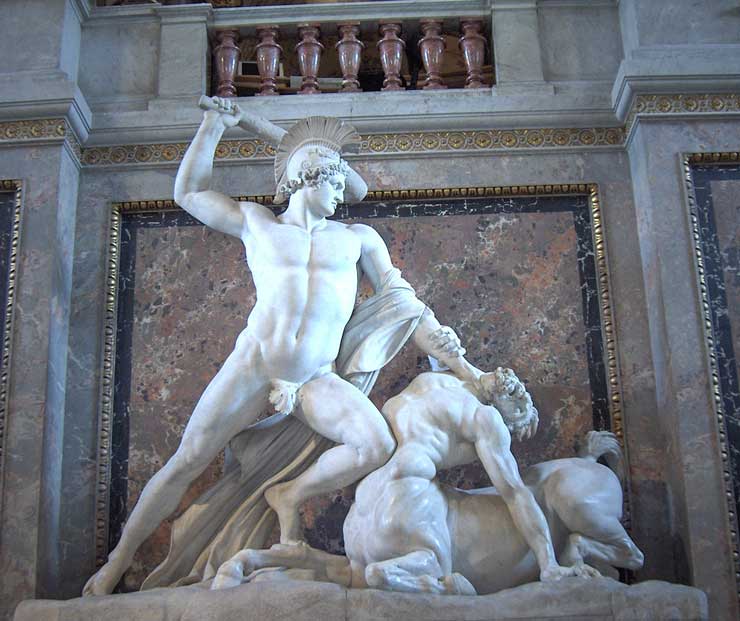
THESEUS, the son of Aethra and Aegeus, on attaining manhood, was by his mother informed of the reality of his parentage. She conducted him to the rock, which he easily removed, and carried the tokens by land to Athens, which proved a very dangerous journey. He killed several famous robbers, and a wild sow of enormous size and fierceness. On arriving at Athens, he was pronounced by his father as king of Athens. Diligent to increase the popularity he had acquired, he delivered the country from a wild bull which had done great mischief in Marathon. As a condition of peace with Minos king of Crete the Athenians had been reduced to paying a yearly tribute of seven youths and as many virgins to that powerful monarch. The unfortunate victims were thrown into the labyrinth built by Daedalus and devoured by the Minotaur. The youths had hitherto been drawn by lot; but Theseus offered himself. Minos, surprised at the arrival of the Athenian prince, received him honourably, afterwards gave him his daughter Ariadne in marriage, and abolished the cruel tribute.
A depiction of Theseus slaying the Minotaur
The achievement raised Theseus to the highest popularty among the Athenians. On his father's death, the common voice supported his claim to the succession. The twelve districts into which Cecrops had divided Attica were become so many independent and often hostile commonwealths. Theseus dissolved all the independent councils and jurisdictions in the several towns and districts, and transferred all the more important civil business to Athens. To satisfy the rich and powerful, who were inclined to opposition, he offered to relinquuish much of his own power, and to appropriate to himself only the cares and dangers of royalty. His next measure was to cement the civil union by the union of religion. To this end he instituted one feast and sacrifice in honour of Athena for all the inhabitants of Attica. This feast he called Panathenaea.
Theseus is said to have lost in the end all authority among the Athenians, and though his institutions remained in vigour, to have died in exile.
After him MENESTHEUS acquired the sovereignty and commanded the Athenian troops in the Trojan War.
After him MENESTHEUS acquired the sovereignty and commanded the Athenian troops in the Trojan War.
0003 - early Sparta, Boeotia, Thessaly, and Attica
The city of LACEDAEMON, also called Sparta, was the most considerable of remote ages. It was little known for any remarkable personages until the reign of Tyndareus, whose wife, Leda, was the mother of Castor and Polydeuces (=Pollux) and the sisters of Clytemnestra and Helen. Clytemnestra married Agamemnon, and Helen married his brother Menelaus. The command of Lacedaemon was given to Menelaus.
Of the two provinces outside of the peninsula, THESSALY and BOEOTIA most attracted emigrants. Thessaly was often subject to floods, which increased the fruitfulness of her soil. This made her the victim of rapine. Thessaly was famous for the turn of its people to horsemanship. Hence may have arisen the story of the Centaurs - possibly natives of Thessaly. Homer implies that they were humans, not of equine form. From the port of Iolcus in Thessaly proceeded the expedition of the ARGONAUTS, which may be summarised thus: Jason, a youth of high birth and spirit, was ambitious of conducting a pirating expedition, and induced young men of distinction to join in the adventure. They directed their course to Colchis, invited by its mines of gold and silver, and returned with the princess of Medea, daughter of the king of that country.
Boeotia is a vale, full of subterrenean caverns, and subject to earthquakes and floods. Cadmus founded the celebrated city of THEBES in Boeotia. No part of Greece was more fruitful in matter for fable and poetry than Thebes. From this we may conclude that Thebes, in what remote age, was a flourishing and powerful city.
OGYGES has the reputation of being the first king of ATTICA. According to tradition, Boeotia, over which he reigned, was subjected to floods, driving out the inhabitants and causing them to establish temselves in the adjoining country of Attica. Anciently there had been towns in Boeotia called Athens and Eleusis. Strabo says that Boeotia was formerly called Ogygia.
The next known prince of Attica was CECROPS, who divided the territory into twelve districts, established just laws, and taught his subjects a more effective mode of defence against the incursions of the Boeotians. His residence was called from his name Cecropia, and was recommended to the patronage of the goddess Athena, from whom the town of Athens was afterwards named.
After a period of growth, civil wars arose, and the country was invaded by sea. Erectheus, later called Erichthonius, acquired the sovereignty in Athens, while Eumolpus established himself in Eleusis. A generation later, AEGEUS, a contemporary of Minos, sat on the throne of Athens.
0002 - Danaus, Perseus, and Pelops
Among the kings of Argos was Danaus, an Egyptian, whose fifty daughters married on the same day the fifty sons of the king of Egypt, and all, except Hypermnestra wife of Lynceus, killed their husbands on their wedding night. Danaus, finding his situation uneasy in Egypt, embarked with his family and followers to seek settlement. He landed near Argos, where Gelanor then reigned. The favour with which he was received by the inhabitants was so extraordinary, that he demanded the sovereignty of the state as his legal right. His claim had no better foundation than a pretended descent from Io. It is also reported that he taught the Argives, who suffered from want of water, to dig wells. Gratitude produced an inclination so violent that Gelanor was constrained to admit him peaceably to plead his right to sovereignty before an assembly of the people. In the fields where the people gathered it was observed that a wolf from a neighbouring mountain killed a bull grazing among a herd. The bill was interpreted to signify their native prince, and the conquering wolf the stranger, and so the kingdom was adjudged to Danaus.
Danaus made his establishment firm, and such was the extent of his power and fame that the people in the Peloponnesus, before called Pelasgians, received the name of Danaans.
Danaus made his establishment firm, and such was the extent of his power and fame that the people in the Peloponnesus, before called Pelasgians, received the name of Danaans.
Danaus was succeeded by Lynnceus, his son-in-law. Acrisius, grandson of Lynceus, acquired influence far beyond the Peloponnesus. Perseus, son of Danae daughter of Acrisius, was the founder of Mycenae, which he made the capital of his dominion. Argos was still governed by its own king, but dependent on the king of Mycenae, who was styled king of "all Argos," a term which implied the whole of Peloponnesus, and not just the city.
Contemporary with Perseus was Pelops, son of Tantalus king of Phrygia. Pressed by superior force in war, Pelops quitted his country to seek better fortune elsewhere. He established himself in Peloponnesus, bringing with him treatures in an amount unknown to the barbarous natives. He married Hippodamia daughter of Oemomaus, chief of Pisa in Elea, whom he succeeded in the sovereignty of that territory. In the course of a long reign he established his influence by the marriages of his vast issue throughout the peninsula, insomuch that it derived from him the name which it retained so many ages.
Astydamia, daughter of Pelops, was married to Sthenelus, king of Argos, son of Perseus. Their son and successor is known for his enmity to Heracles, who was also descended from Perseus and Pelops. Heracles was born at Thebes in Boeotia. He was a prince commanding armies which were the ministers of his great actions.
The hatred of Eurystheus continued after the death of Hercules to his children and friends. These left Pelopennesus for Athens. Eurystheus, monarch of Argos, invaded Attica, but was slain by the Athenians. Atreus, son of Pelops, and uncle of Eurystheus, had been entrusted by Eurystheus with the regency of his Peloponnesian dominions during the Attic expedition. On the death of his nephew, Atreus assumed sovereignty. The claims of the house of Pelops extended over nearly all the Peloponnesus. The Argive sceptre then devolved to Agamemnon, son or grandson of Atreus.
Wednesday, 30 March 2011
0001 - Crete, Minos, Argos
In CRETE was established a system of laws which is said to have enforced civil order and secured civil freedom to the Cretan people, and which became the general foundation of Grecian legislation and jurisprudence. The general polity of Crete rested upon two principles: that freemen should all be equal; and that they should be served by slaves. The lawgiver therefore allowed no private property in land. The education of youth was directed to form soldiers. A severe morality, which valued modesty and temperance, was enforced by law. This system may have been established by a band of adventurers from the East, who seized the land and compelled the ancient inhabitants to labour.
The glory of this establishment is generally given to MINOS, a prince of Crete; but some attribute it to Rhadamanthus, in a still earlier age. Minos was an able prince, not unaquainted with useful arts. His measures against pirates were so judicious that he established security throughout the Aegean. By means of his fleet he extended his authority far among the Grecian islands. Before the reign of Minos, such had been the excesses of piracy, that all the shores of Greece had been deserted.
Some settlements, however, had been made, capable of resisting piratical attempts from sea, namely, SICYON, on the northern coast of the Peloponnesus, and CORINTH, founded in the neighbourhood of the former. By land Corinth was the key of communication between northern and southern Greece; by sea it became the emporium for all that passed between the east and west.
The superior antiquity of Sicyon among Grecian cities is not undisputed; ARGOS, the first to acquire political eminence, is said to be earlier. Argos was founded by Inachus, said to be the son of Ocean, perhaps implying that he came from the sea. Some writers, however, attribute the foundation of the city to Pharoneus.
Towns usually grow so impercetibly, that their foundation cannot be referred to particular eras and persons. Those cities whose founding is attributed to a particular person are likely to be colonies.
The first chief of Argos (Inachus or Phoroneus) was an Egyptian colonist who brought the natives to submit to his government. Io, daughter of one of those princes, had an amour with Zeus, was by him transformed into a cow, in that shape travelled to Egypt, and there became a goddess. It is by others related, that some Phenician merchants brought a cargo of their manufactures to Argos, lured or forced many of the Grecian women into their vessels, among them Io, and sailed away. The stolen princess acquired, it is not accounted how, the reputation of a goddess.
Subscribe to:
Posts (Atom)